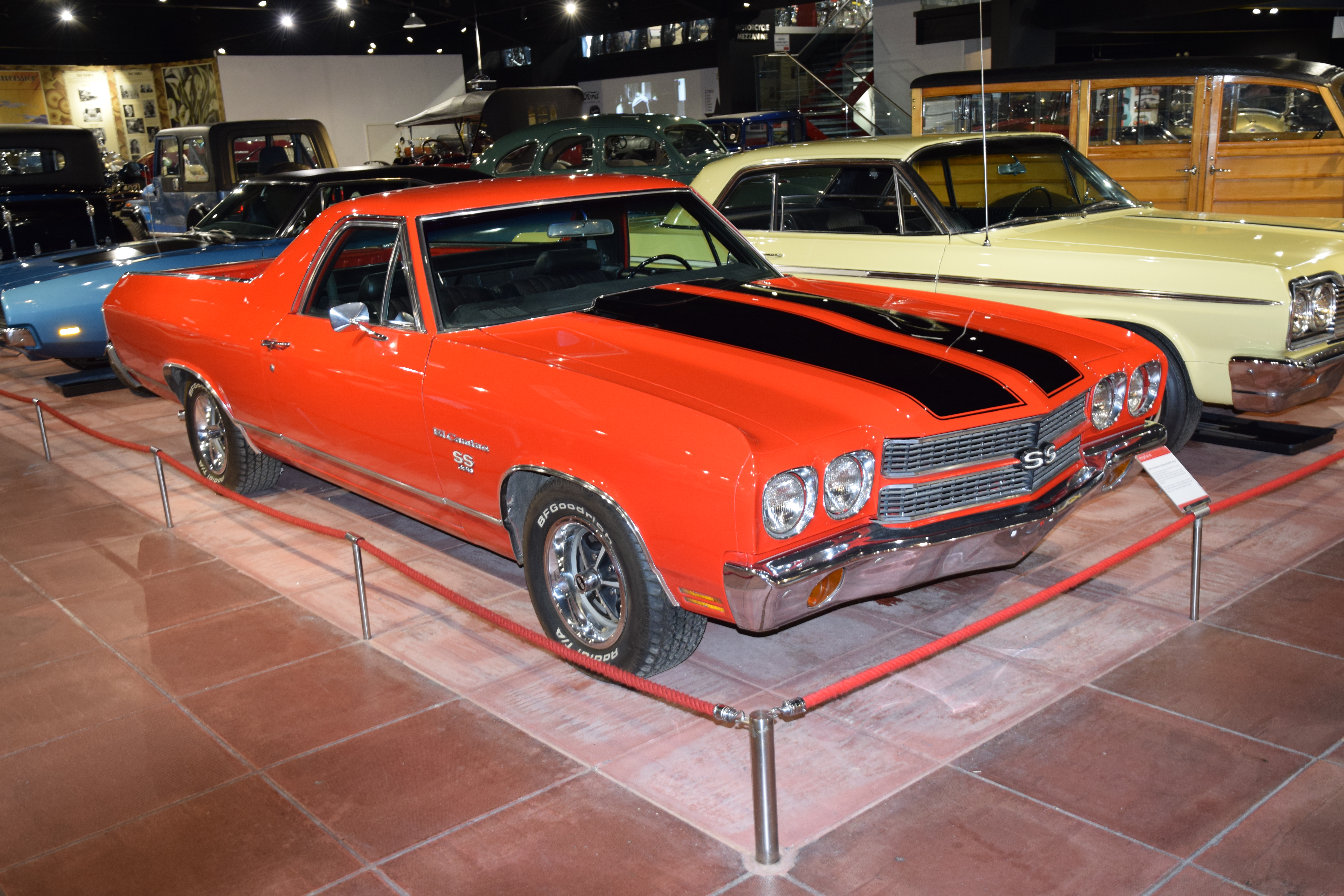
Chevrolet's El Camino occupies a singular space in American automotive history: it is a car that carries things, a truck that handles like a coupe, and for 1970, a genuine performance machine capable of running the quarter-mile in the upper 13-second range. The Super Sport package brought SS badging and a range of big-block engines that started with the 325-horsepower 396 (actually 402 cubic inches) and climbed all the way to the 450-horsepower LS6 454 — the same engine that turned the Chevelle SS into a legend. There was nothing else quite like it.
Chevrolet had been building the El Camino on its A-body platform since 1964, but by 1970 the car-truck had grown into something remarkable. Riding the same chassis as the Chevelle, it shared every powertrain option, suspension component, and body engineering advance that made the Chevelle SS one of the era's benchmark performance cars. For 1970 that meant access to Chevrolet's most powerful big-block engines at a time when the horsepower wars were reaching their peak.
The Super Sport option transformed the El Camino from capable to formidable. Buyers could choose the L35 396 (402 cu in) with 325 horsepower for a balanced street machine, step up to the L34 350-horsepower version, or specify the L78 with its solid lifter cam, aluminum high-rise intake, and 375 horses. But the true headline for 1970 was the 454. The LS5 offered 390 horsepower and 500 lb-ft of torque through a single four-barrel carburetor, providing effortless thrust with everyday drivability. The LS6 — rated at 450 horsepower and 500 lb-ft — used a Holley 800 CFM carburetor and is regarded as one of the finest production V8 engines ever built by General Motors.
What made the El Camino SS 454 uniquely compelling was its dual identity. The flat cargo bed behind the cab was genuinely useful — you could haul motorcycles, lumber, or camping gear — while the front end delivered sports car acceleration. A tested LS6 car would cover the quarter-mile in the upper 13-second range at approximately 106 mph, numbers that rivaled dedicated muscle cars carrying none of the utility payload. Chevrolet built 47,707 El Caminos total in 1970, and the SS 454 variants represent the peak of what this unusual machine could be: practical transportation with a racing heart.