Muscle Cars · Aero Warriors
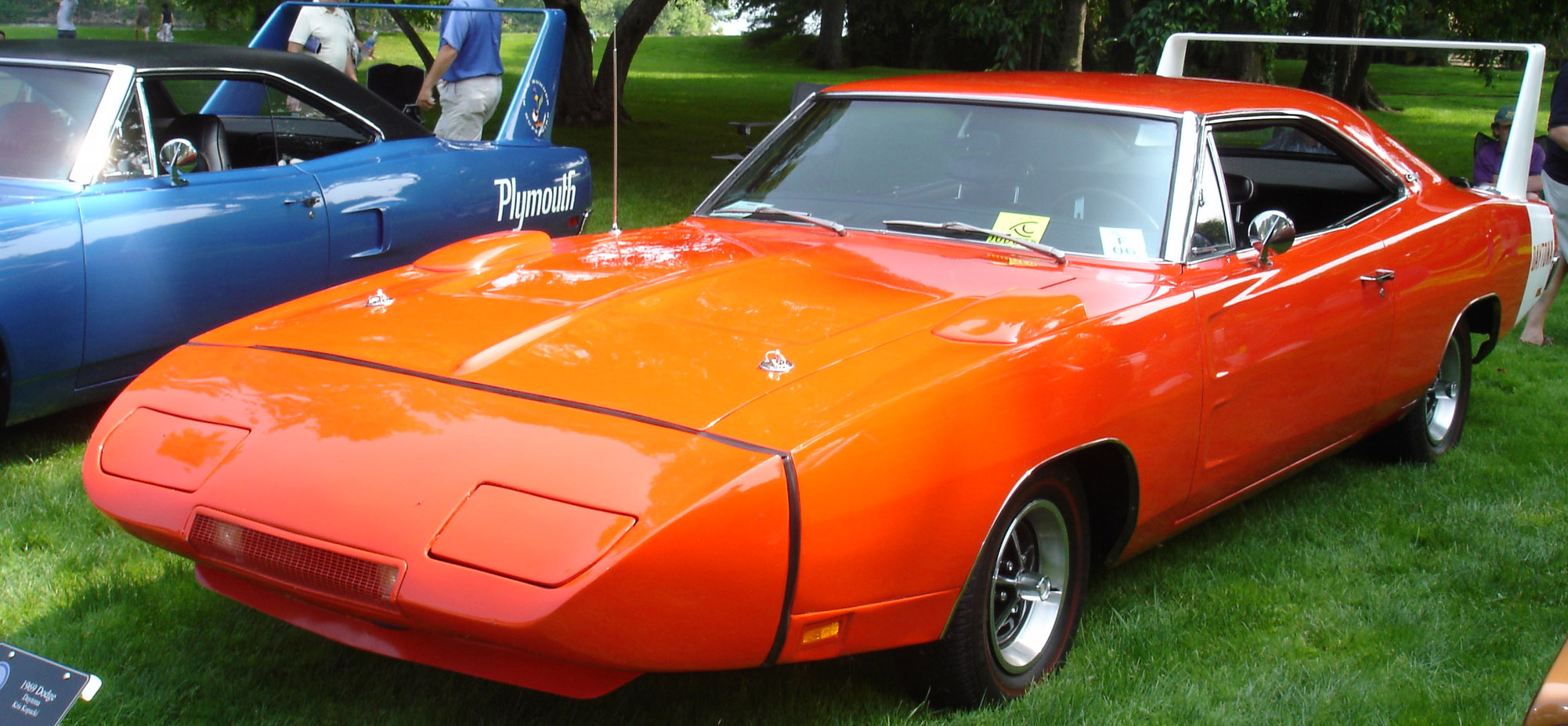
1969 Dodge Charger Daytona
Built to break 200 mph — the winged Daytona conquered NASCAR and terrified every rival on the superspeedway.
Hero: Karrmann / CC BY-SA 3.0 · Wikimedia Commons
Built to break 200 mph — the winged Daytona conquered NASCAR and terrified every rival on the superspeedway.
Of the thousands of muscle cars built in the golden era, only the 1969 Dodge Charger Daytona wore a nose cone and a two-story rear wing to work — because Dodge needed to win at Daytona and Talladega, and aerodynamics was the weapon of choice.
Dodge engineers faced a simple problem heading into the 1969 NASCAR season: the standard Charger's recessed rear window and tunneled-back roofline created aerodynamic drag that hurt top speed where it mattered most — on the long superspeedway straightaways. The solution was radical. Engineers grafted a pointed steel nose cone onto the front and bolted a massive 23-inch-tall stabilizer wing to the rear deck on adjustable struts. The result was the Charger Daytona, a street-legal racing homologation special unlike anything American manufacturers had produced.
To qualify for NASCAR competition, Dodge was required to build at least one Daytona for every two dealerships in the country. That meant a minimum of roughly 500 road cars — and 503 were built for the U.S. market. Each came standard with the 440 Magnum V8, producing 375 horsepower at 4,600 rpm. Buyers willing to pay extra could tick the box for the legendary 426 Street Hemi, with 425 horsepower fed through dual four-barrel Carter AFB carburetors. Only 70 Daytonas left the factory with the Hemi under that distinctive elongated hood.
On the track, the investment paid off immediately. Charlie Glotzbach qualified the Daytona at Talladega at 199.466 mph, and Richard Brickhouse drove one to victory in the Talladega 500 in September 1969 — the race's inaugural running. The following March, Buddy Baker piloted a Daytona to an officially timed 200.096 mph, making it the first NASCAR vehicle to break the 200 mph barrier. The winged cars won six races across 1969 and 1970 before NASCAR changed its rules to slow them down.
Today, survivor Daytonas — especially Hemi cars — rank among the most valuable American muscle cars ever built. The combination of extreme rarity, dramatic appearance, and genuine racing pedigree makes them centerpieces of any serious collection. The Daytona represents the moment when Detroit's horsepower wars went aerodynamic, and the results were spectacular.
The numbers that matter, each cited to its source. Where a figure is disputed or unconfirmed we hedge or leave it out — never guessed.
Standard engine on all 433 of the 440-equipped Daytonas. 139 paired with 4-speed manual, 294 with TorqueFlite automatic.
Optional engine; only 70 of 503 U.S.-built Daytonas were Hemi-equipped. 22 with 4-speed manual, 48 with TorqueFlite automatic.
| Year | Trim | Body | Built |
|---|---|---|---|
| 1969 | Charger Daytona | 2-door hardtop coupe | 503 |
Numbers-matching engine, factory options, the day it was built — these are the people who can confirm what your car left the factory as. We point you to the marque authority; we never reproduce their records.