
Muscle Cars · Pony Car
1970 Plymouth 'Cuda
The Hemi 'Cuda: pure muscle legend, wrapped in one of Detroit's most beautiful bodies.
Hero: Crisco 1492 / CC BY-SA 4.0 · Wikimedia Commons
The Hemi 'Cuda: pure muscle legend, wrapped in one of Detroit's most beautiful bodies.
Few cars stop a room like the 1970 Plymouth 'Cuda — a machine that arrived at the height of the muscle car wars wearing a brand-new body and carrying the most fearsome engine options Detroit had ever bolted beneath a hood.
In 1970, Plymouth tore up everything they'd done before and started fresh. The all-new E-body design gave the 'Cuda — the high-performance heart of the Barracuda line — wide hips, a long hood, and a fastback roofline that looked like it was already doing ninety standing still. Shared with the Dodge Challenger across the same platform, the E-body was a declaration: this era of American muscle deserved a proper stage, and Plymouth had just built one.
Then came the engines. Start with the willing 340 small-block, smooth and eager for the street. Step up through the muscular 383, then arrive at the 440 — a big-block that filled the engine bay with authority. At the top of the range sat the 440 "Six Barrel," wearing three two-barrel carburetors in a row, each one opening in sequence as your right foot pressed harder, the sound building from a mutter to a roar. And above even that — almost mythological in reputation — was the 426 Hemi. A car wearing that badge earned its own name: the Hemi 'Cuda. Owners didn't drive it so much as manage it.
The 1970 'Cuda arrived just as the muscle era was reaching full boil, and it became one of the defining poster cars of that golden moment — the kind of image that teenagers pinned to bedroom walls and never quite forgot. Today, the E-body 'Cuda is among the most passionately pursued collector cars in the world, particularly in Hemi trim. Whether you come to it as a restoration project, a show-quality trophy, or simply something beautiful to stand beside on a Sunday morning, the 'Cuda rewards every bit of the attention you give it.
The numbers that matter, each cited to its source. Where a figure is disputed or unconfirmed we hedge or leave it out — never guessed.
The standard 'Cuda V8.
Bore & stroke per Chrysler RB engine (Wikipedia).
The Hemi 'Cuda is among the most valuable muscle cars ever made. Bore/stroke/compression per Chrysler Hemi engine (Wikipedia).
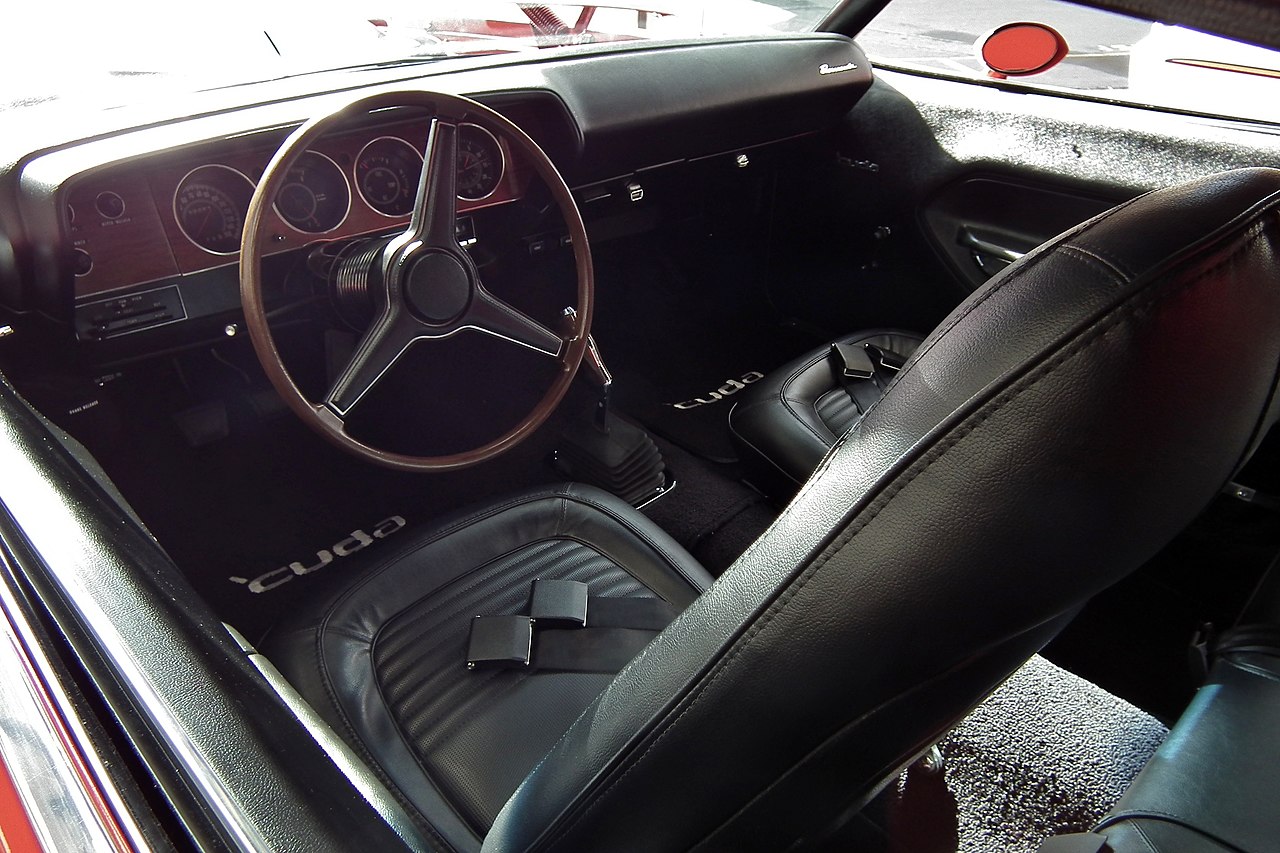
Real engine-bay and cockpit photos, shared by enthusiasts under Creative Commons.

Factory safety campaigns the U.S. government has on record for this model year — not our opinion, the real database.
Source: NHTSA recalls API (api.nhtsa.gov), public domain. Always confirm an individual car’s recall and repair history by VIN before buying.
Numbers-matching engine, factory options, the day it was built — these are the people who can confirm what your car left the factory as. We point you to the marque authority; we never reproduce their records.