Muscle Cars — Budget Muscle
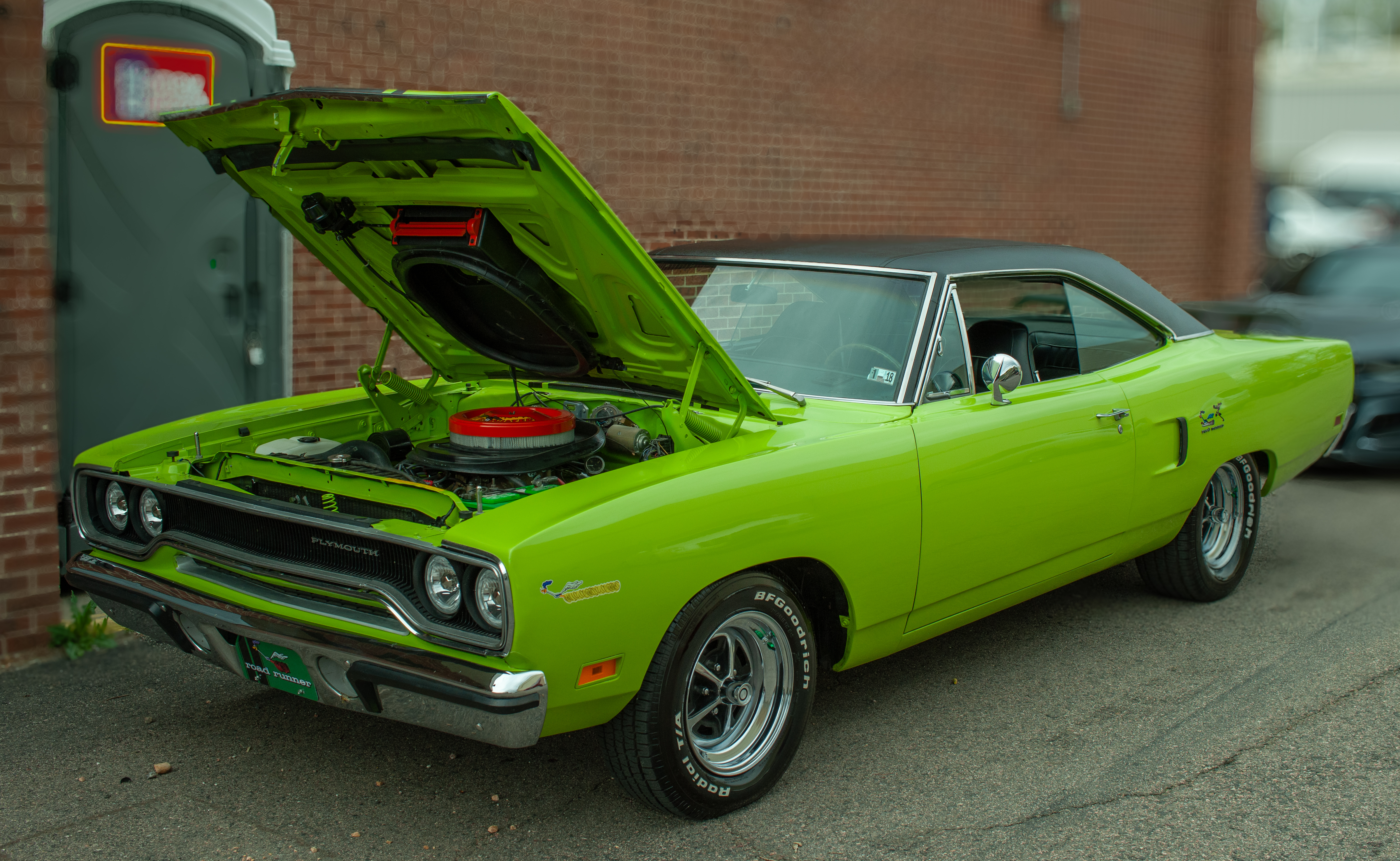
1970 Plymouth Road Runner
The cartoon bird with a real bite — budget muscle, beep-beep horn, and enough cubic inches to humble anything on the street.
Hero: BUTTON74 / CC BY-SA 4.0 · Wikimedia Commons
The cartoon bird with a real bite — budget muscle, beep-beep horn, and enough cubic inches to humble anything on the street.
Plymouth built the Road Runner for one purpose: deliver maximum muscle at minimum price. The 1970 model carried on that mission with three potent engine choices — a 335-hp 383 Magnum as standard fare, an optional 390-hp 440 Six Pack bristling with three Holley two-barrel carbs, and the legendary 425-hp 426 Street Hemi for drivers who demanded the absolute best. Wrapped in bold High Impact colors and announced by its signature beep-beep horn, the 1970 Road Runner remains one of the most honest expressions of the muscle car era.
When Plymouth introduced the Road Runner for 1968, the goal was simple: strip away the luxury, keep the horsepower, and price it so working people could actually afford to go fast. By 1970 the formula had been refined into something close to perfection. The standard 383 Magnum V8 — breathing through a hot cam and free-flowing exhaust — produced 335 horsepower and 425 lb-ft of torque, enough to embarrass far more expensive cars at a stoplight.
The real stars of the 1970 lineup were the optional powertrains. The A12 440 Six Pack used three Holley two-barrel carburetors on an Edelbrock aluminum intake to push the 440 cubic inch RB engine to 390 horsepower and 490 lb-ft of torque. It came standard with a Dana 60 rear axle and 4.10 gears — Plymouth was serious. For the truly committed, the 426 Street Hemi offered 425 horsepower through its famous cross-ram dual-quad setup, with hemispherical combustion chambers that had dominated NASCAR and drag racing throughout the 1960s.
Plymouth dressed the 1970 Road Runner in a palette of aggressive High Impact colors — Vitamin C orange, Moulin Rouge red, and In-Violet purple — that made subtle an impossible aspiration. Despite its budget origins, the Road Runner offered genuine performance credentials, and the 1970 model year closed an era: it was the last year for the convertible body style (just 834 built), and muscle car regulations would soon tighten the reins on displacement. Today a well-documented 1970 Road Runner, especially in Hemi or Six Pack trim, ranks among the most sought-after American classics.
The numbers that matter, each cited to its source. Where a figure is disputed or unconfirmed we hedge or leave it out — never guessed.
Standard engine. Shared block with 440 but with smaller bore. 10.5:1 compression for the high-output Roadrunner tune.
Option code A12. Three Holley two-barrel carbs on an Edelbrock aluminum intake. Dana 60 rear axle with 4.10:1 gears standard.
Optional at significant cost. Hemispherical combustion chambers. Cross-ram dual-quad induction. Extremely rare in Road Runner trim.
| Year | Trim | Body | Built |
|---|---|---|---|
| 1970 | Road Runner Hardtop | 2-door hardtop | ~40166 |
| 1970 | Road Runner Convertible | 2-door convertible | 834 |
Numbers-matching engine, factory options, the day it was built — these are the people who can confirm what your car left the factory as. We point you to the marque authority; we never reproduce their records.